EoCoE • Science Challenge

Materials for Energy

Description


Scientific Leader: Edoardo Di Napoli, Alessandro Pecchia

This project aims to upgrade libNEGF into the exascale domain, creating the first freely available library tool able to tackle large-scale calculations of non-equilibrium charge carrier transport. This will be the first tool to fully encompass all the relevant interaction mechanisms in order to obtain realistic simulations of nanoscale optoelectronic devices.

The applications of libNEGF will target 2D heterostructures, traditional III- V multi quantum-wells, nano-electronic device simulations (both 2D and 3D) as well as nano-thermoelectric devices.

The goal is to expand the libNEGF library to create a versatile quantum simulation tool that can handle industry-relevant simulations of optoelectronic hetero-structures based on 2D materials with DFT level accuracy. This includes accounting for light-carrier interactions, electron-phonon scattering, and excitonic effects. To achieve this, the libNEGF code must be made scalable on pre-exascale and future exascale systems by developing new algorithms, data distribution methods, and platform-aware kernels.

The NEGF formalism is a computationally intensive method dealing in essence with large dense tensors in configuration, energy, and momentum space. To address the memory scaling issue, strategies such as data distribution, data pipelining, overlapping of communication and computation, and reduced-precision storage of intermediate results must be implemented.

We aim introducing further layers of parallelization and distribution, develop a flexible block-dense structure scheme, consider the effect of data compression and accuracy, and design a new data flow strategy that maximizes the interleaving of computation with communication. In addition, we aim at achieving multi-level parallelism and interoperability between different platforms, such as NVIDIA, Intel, AMD, ARM, etc., by developing an automatic framework that combines compiler-based code generation with heuristic performance prediction tools that evaluate the generated code through modeling of the computation and communication patterns of the underlined algorithm.

LibNEGF is already interfaced to DFT codes such as dftb+ or the finite-element device simulator tiberCAD. Additional interfaces are in progress, with BigDFT with a wavelet or LCAO basis sets, or tools exploiting maximally-localized Wannier representation of the local basis.

To validate the tool’s capabilities and ability to perform at exascale, it will be tested on a few identified structures, such MoS2/WS2 multilayers and MoS2/graphene with varying compositions and transport orientations. The tests will focus on exciton splitting ability and internal quantum efficiencies, representing the first demonstration of NEGF simulations on large-scale hetero-structures of this type.

Exascale Codes for Materials Modelling

Codes

No alt text
01
Alya

is a high performance computational mechanics code that solves complex coupled multi-physics problems, mostly coming from the engineering realm. Alya will be deeply refactored in order to be able to address heterogeneous computing nodes. A very strong effort on linear algebra is planned for both the fluid and the solid problems handled in the two tasks foreseen in the wind scientific challenge.

Read More
No alt text
02
Meso-NH

is an open-source non-hydrostatic mesoscale atmospheric model developed by the Centre National de Recherches Météorologiques (CNRM – Météo France/CNRS) and the Laboratoire d’Aérologie (LA – UPS/CNRS) [1]. This LES model has recently been extended to wind farm flow simulations by IFP Energies Nouvelles, using an Actuator Line Model (ALM) of the wind turbines [2]. It enables to simulate the interactions between wind turbines and surrounding atmospheric flows from meso- to micro-scales. A realistic atmosphere can be simulated with this model, including roughness effects, thermal effects, complex terrains, or even complex micro-physical phenomena.

Read More
No alt text
03
waLBerla-wind

is an exascale-enabled tool allowing for the simulation of neutral atmospheric boundary layers and wind turbines based on the Lattice-Boltzmann method and the waLBerla framework. In EoCoE-3, it will be employed as an alternative solution for modelling wind turbines and wind farms, efficiently using heterogeneous computing resources. Thanks to the code generation techniques, vectorization via SIMD intrinsics and reduced floating-point precisions, waLBerla-wind can perform real-time simulations of the interactions between wind farm clusters.

Read More
From HPC Research to Energy Applications

Results

CFD simulation of flow over a wind farm

The most important aspect of the Material for Energy scientific challenge of EoCoE is to join scientific and technical competences from the most important institutions and research centres in Europe in order to discover novel materials that allow the production of electricity by harvesting energy from sunlight, salinity gradients and temperature gradients. In order to achieve this challenging purpose, we are developing codes based on theories at different length scales able to be run efficiently on the next generation of supercomputers that are reaching exascale computing performance, i.e., supercomputers able to perform one billion billion (1018) floating-point operations per second.

Thanks to the EoCoE project, four different European Institutions (CIEMAT, CNR, ENEA and FZJ) collaborated in understanding the transport mechanisms underlying photovoltaic devices based on the Silicon Heterojunction technology. Amorphous-crystalline heterointerfaces play a crucial role in the photovoltaic operation of the devices, but the microscopic mechanisms of transport and recombination mechanisms at the interface are not yet well understood. The main purpose here is to design and develop cutting-edge computational methods and HPC-ready software for photovoltaic device simulations at atomistic resolution in the most insightful and predictive way. The results look very promising for further research since we have simulated the transport at the interface between passivated Silicon and amorphous Silicon by taking into account the presence of defects in a realistic structure, and increased the speed of specific algorithms used by the code more than six times. Moreover, EoCoE has signed a MoU with MAX CoE to collaborate on the optimization of the pre-processing of the electronic properties (using QUANTUM ESPRESSO) before inserting the definition of these properties in the transport calculation.

Another objective reached by the collaboration of CEA and Maison de la Simulation is to assess the best electrode/electrolyte combination to optimize the electricity production in electrochemical systems. Electrical power production from salinity gradients harvests the free energy lost during the mixing of sweet water with salty water in river estuaries. The main technologies developed for this purpose to date exploit the electric potential differences applied across membranes. We analyse an alternative approach based on capacitive mixing. As part of this approach, we are investigating the electrode structure which optimizes a blue energy production, and which is the compositions that will enable optimal performances of thermo-electrochemical cells. Five-hundred structures never seen before were passed through the artificial intelligence model to predict the vertical energy gaps between the reduced and the oxidized species, necessary to predict electrochemical properties (e.g. redox potentials). Such a tool has the potential to accelerate the research of the best electrode/electrolyte combination to optimize the energy harvesting process.

Working with the University of Bath (research group of Prof. Alison Walker), we have been able to achieve good results on optoelectronic devices based on two classes of emerging photovoltaic materials, namely organic molecular semiconductors and metal-halide perovskite semiconductors. Both types of cells are cheap to make but have some stability concerns. Organic solar cells are only 12% efficient whereas perovskite solar cells are close to 23% efficiency. However, perovskite cells are notorious for poor stability and current-voltage hysteresis. Our purpose is to design and develop HPC ready software for device models of both cell types extending the simulations to systems of several thousands of atoms to understand degradation mechanisms and find materials and architectures that enhance stability.

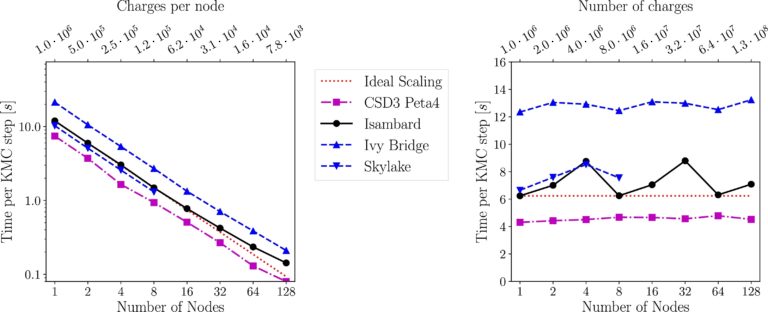
The specificities of these two materials necessitate different computational approaches. Therefore, the development, implementation and application of simulation methodologies amenable to studying phenomena at a broad range of length and time scales has evolved. We are developing a pair of Monte-Carlo codes (KMC and DMC). Notably, algorithmic improvements and other optimization work on the KMC code enabled access to organic molecular semiconductors models that contain millions of charges with good parallel scaling. We demonstrated good performance scaling for 128 million charges up to 128 nodes on Intel and ARM architectures, making possible to model doped organic semi-conductor containing 20,000 charges, while the previous state of the art code, using approximate electrostatics, could perform KMC simulations with systems containing less than 100 charges.

Metal-halide perovskites are currently attracting intense interest for application in optoelectronic devices, due to their remarkable efficiencies in spite of low temperature synthesis methods. In order to test the influence of large polarons on the value of phenomenological parameters, we derived expressions for scattering of polarons by ionised impurities and acoustic phonons, and implemented them in the DMC simulator in order to compute and compare the temperature dependent mobilities of polarons and band electrons in three metal–halide perovskites. We investigated the role played by polaron formation and we found that the main effect is to reduce the mobility of electrons, but the temperature dependence is not altered. This is important for understanding the degradation mechanisms and for the design of solar cells based on metal-halide perovskites with enhanced stability in the performance of the device.

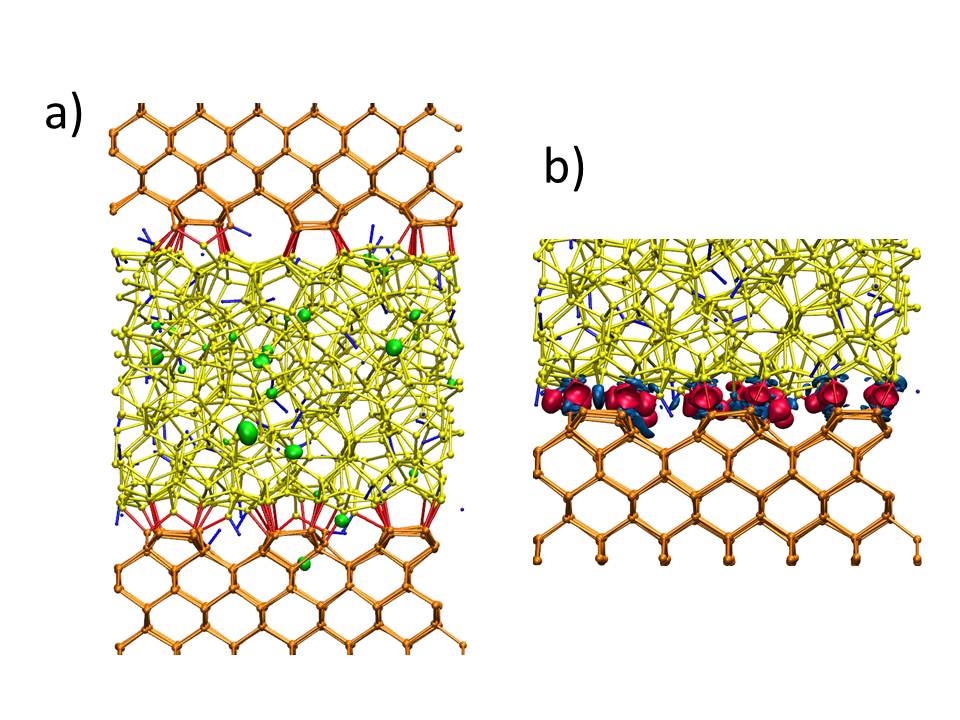
The figures below are snapshots of the results published in scientific articles. Please refer also to the publications section for more details.
Fig. 1. Towards exascale simulations of a-Si:H/c-Si interfaces. a) Local density of states (green isosurface) of the intragap states of a-Si:H/c-Si interface at room temperature. They correspond to defect states localized both in the bulk of a-Si and at the a-Si:H/c-Si interface. The Silicon atoms and their bonds are in orange in the c-Si side and are in yellow in the a-Si:H side, Hydrogen atoms and bonds with Silicon atoms are in blue. Bonds between c-Si and a-Si are in red. a-Si = amorphous Silicon; c-Si = crystal Silicon. b) The c-Si/a-Si:H interface and the difference at of the charge density between the total system and the c-Si and a-Si:H systems considered as isolated slabs at the end of the room temperature thermalisation. Red (blue) isosurface is positive (negative) difference of the charge density. The electron charge is accumulated along the c-Si/aSi:H interface and depleted from the nearby c-Si and a-Si:H surfaces. (Article from Francesco Buonocore, Massimo Celino, Pablo Luis Garcia, Simone Giusepponi, Rafael Mayo-Garcia. WSC 20: Proceedings of the 2020 Winter Simulation Conference, IEEE press (accepted), http://meetings2.informs.org/wordpress/wsc2020/)
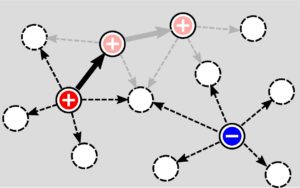
Fig. 2. Organic and perovskite solar cells. Schematic sketch of one KMC step, which consists of calculation of the propensities for all possible hops (dashed arrows) and moving one particle to a new site after accepting a particular hop (solid arrows). Subsequent steps are shown as grey arrows. Kinetic Monte Carlo (KMC) simulations of a system of (electrically) charged particles require many evaluations of the change in electrostatic energy associated with “possible” moves of individual particles, but only one such move is selected per KMC step. (from article by W. R. Saunders, J. Grant, E. H. Muller and I. Thompson, J. Comp. Phys. 410, 109379 (2020) DOI: 10.1016/j.jcp.2020.109379)
Fig. 3: Organic and perovskite solar cells. Strong (left) and weak (right) scaling experiments. The time per KMC step is plotted against number of compute nodes. For the strong scaling experiment the total number of charges is N = 1,000,000. We mitigate the potential explosion in the computational complexity of the problem with system size by deriving a modified version of the well-known Fast Multipole Method which exploits the fact that the change in the charge distribution is small for each possible move, leading to an algorithm which scales linearly in the number of particles per KMC step. We present an implementation of the algorithm in a performance portable high-level Python user interface which generates low-level code optimised to the system architecture, and demonstrate its parallel scalability for 1 million charges and 8192 cores (from article by W. R. Saunders, J. Grant, E. H. Muller and I. Thompson, J. Comp. Phys. 410, 109379 (2020) DOI: 10.1016/j.jcp.2020.109379).
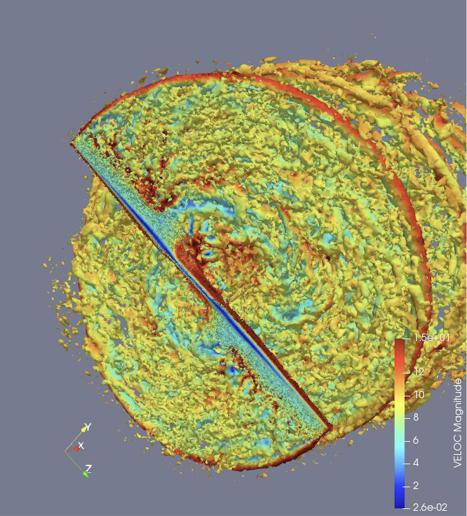
Figure 2 – Full rotor simulation for NREL-VI blades using the sliding mesh approach in Alya. Image credits: H. Owen, Barcelona Supercomputing Centre.
FULL ROTOR

Full rotor simulations

Our second objective is to perform LES simulations of the rotating wind turbine blades commonly known, as full rotor simulations. The simulation of the rotation of the blades is possible thanks to a sliding mesh approach that is being developed within EoCoE-II. The blade deformation will be taken into account by using Alya’s solids module and its Fluid-Structure Interaction capabilities. Figure 2 shows the Q-vorticity isosurfaces for the flow behind the rotating blades of an NREL-VI wind turbine. Despite such simulation could also have some interest for wind energy companies, we expect that the main interest for this technology should come from wind turbine manufacturers. EoCoE-II has obtained a support letter from Vestas, and we expect that we can provide the industry with a useful technology by the end of the project.

Videos with research results using Alya simulations on wind flows can be found here

EoCoE team introduces order of magnitude improvement in wall modelling implementation for Finite Elements

Large-eddy simulation (LES) has emerged as a valuable tool for the simulation of turbulent flows at high Reynolds numbers and complex geometries, typically encountered in practical engineering applications. In this approach, the larger dynamically important eddies are directly resolved, whereas the smaller ones are assumed to have a universal character and are therefore modeled.

Nearly all real-world problems include a boundary that acts as a wall where the velocity is zero. In the case of Atmospheric Boundary Layer (ABL) flows that are of interest for Wind Energy, the ground is the wall. For wall-bounded flows, the computational cost becomes prohibitively expensive since the dynamically important eddies in the near-wall region become smaller as the Reynolds number increases, and thus, extreme mesh refinement is required to resolve them. Modeling the inner part of the boundary layer with a semiempirical wall model, instead of resolving it, is therefore a key ingredient for high Reynolds numbers flows to be solvable with LES. Even with the most powerful Exascale Supercomputers that will be available in the upcoming years, wall resolved LES simulations of Atmospheric Boundary Layer flows will not be feasible.

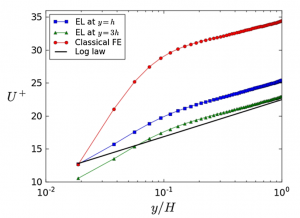
In a recent publication entitled “Wall-modeled large-eddy simulation in a finite element framework” we have improved the wall modelling implementation that has traditionally been used by the Computational Fluid Dynamics Finite Element community. When comparing with the traditional approach the error in the prediction of the mean velocity for high Reynolds number flows has been reduced by more than an order of magnitude. For Atmospheric Boundary Layer flows that have a particularly high Reynolds number this has been a key enabler. The traditional approach used by the Finite Element community would predict an average velocity that is approximately twice the correct value, rendering the results of little or no real use. With the improvements we have implemented the error is significantly reduced and Finite Elements become a very competitive solution for ABL flows. For y/H >0.06, that covers the region of interest of wind energy applications, an excellent prediction is obtained.

Figure 2 – Full rotor simulation for NREL-VI blades using the sliding mesh approach in Alya. Image credits: H. Owen, Barcelona Supercomputing Centre.
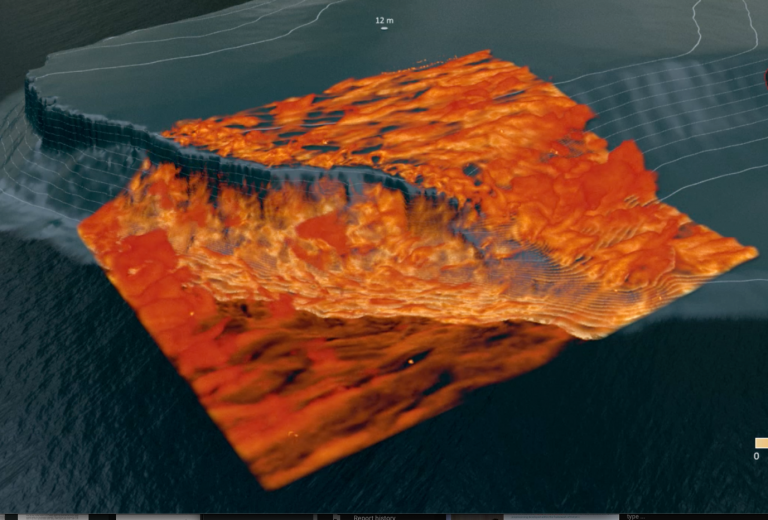
Figure 4 – Flow over the Bolund Hill
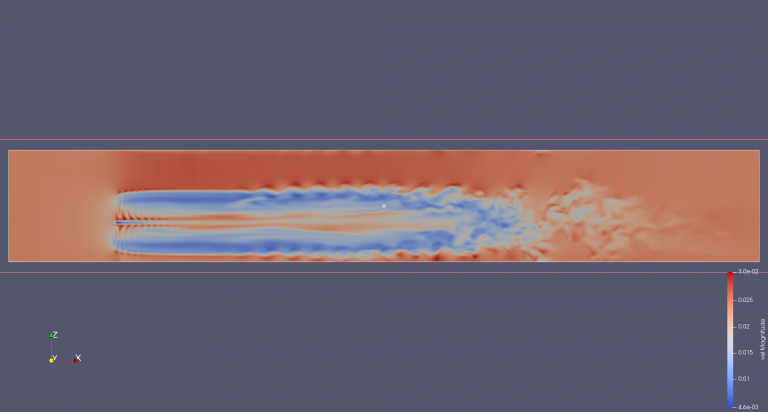
Figure 5 – Velocity magnitude for the Hornamossen benchmark

EoCoE team improves wind turbine simulation using Lattice-Boltzmann method

In order to better understand the flow physics in a wind farm, we need to compute the detailed flow characteristics like wind velocity, turbulent eddies, etc. in a reasonable time and with enough precision. At this stage only high-fidelity Navier-Stokes based Large-Eddy-Simulation (LES) solvers or even meteorological LES flow solvers are able to accurately reproduce such flows, and have been used rather extensively in the wind energy community. Such simulations enable the understanding of some flow phenomena and are very helpful in the improvement of analytical models. However, due to their high computational cost, only canonical cases are considered (single to few turbines), and full wind farm simulations have only been considered either for demonstration purposes or employing mesh resolutions that are not sufficient to accurately represent the flow physics.

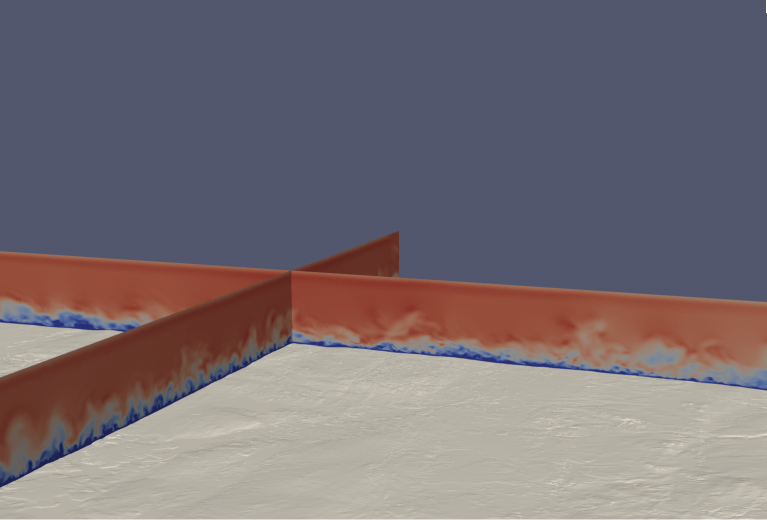
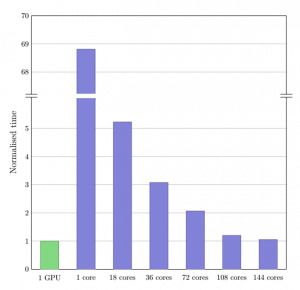
To address this issue, FAU University together with IFPEN are currently implementing actuator-line based wind turbine models in the waLBerla LBM flow solver, with particular attention devoted to the collision operators. Whereas the Lattice-Boltzmann method is well-suited for lower Reynolds number regimes, standard collision operators suffer from instabilities at the high Reynolds numbers observed in wind energy applications. To obtain a stable and meaningful simulation, several investigations are conducted, typically using the Single and/or Multiple Relaxation Time collision operators together with different subgrid-scale models, such as e.g. the Smagorinsky and the WALE models. As this approach failed to stabilize the simulation sufficiently, more advanced collision operators, namely entropic, regularised, and cumulant-based are studied. For the wind turbine application, the cumulant Lattice-Boltzmann methods performed best in terms of stability. They have already been validated considering single or tandem wind turbines, and are being ported to Graphical Processing Units (GPU). The following figures illustrate the obtained results using CPU and GPU resources for the NewMexico wind Turbine. For this compressible simulation, Smagorinsky model is used with D3Q27 stencil and SRT collision operator. The simulation on one GPU (NVIDIA P100) substantially and expectedly outperforms the simulation on one CPU core (Intel Skylake G-6140) without any accuracy loss. Eight full nodes, i.e. 144 CPU cores, are required to obtain the same time-to-solution for both CPU and GPU systems.

Figure 6 – Velocity field
Figure 7 – Normalised time-to-solution for different hardware setups. 30000 time steps were executed on Nvidia P100 GPU and Intel Skylake G-6140 CPU for a domain consisting of approximately 20 million cells with one single wind turbine.
Scientific publications related to the Wind for Energy challenge.

Publications

All the EoCoE-II publications are available here

About Company

Innovating for a Sustainable Future

Rays of Progress & Solar Success serves as a powerful beacon, embodying the transformative journey toward a future powered by the boundless Energy of the sun. It's a vision where each

Partner Awaits

Harness the power of water with our AquaForce.

Global Experts

Wind turbines Powering a greener tomorrow.

0 k

Project Success

0 +

Clients Reviews

0 +

Team Members

0 +

Winning Awards

OUR EXPERIENCE

Solar Passion Unveiled Our Story

Business, or everyday living, imagine a world where solar success is not just an aspiration but a reality driven by the Rays of the sun.

Hybrid Energy
Solar Panel
Wind Turbines
Expert Member

Solar Design Engineer

No alt text
Steve Rhodes
Senior Manager
No alt text
Lisa Thompson
Senior Engineer
No alt text
David Martinez
Senior Technician

25,000 Customer
Satisfaction services

consultation

High Quality Solar Energy Solutions

Solar Powering Your Sustainable Scene is a vibrant and compelling phrase that conveys the idea of integrating solar energy into various aspects of life to create a sustainable

⚙

Work in Progress

This section is currently being updated. Please check back soon for more information.