EoCoE • Science Challenge
Fusion for Energy
Description
Scientific Leader: Yanick Sarazin
With the commissioning of large machines like the ITER tokamak, controlled fusion is poised to make huge step forward towards mastering the energy of the stars for a civil usage. The steady international progress regarding the achieved fusion performance gain – the ratio of the generated fusion power over the injected power – relies on our ability to understand, predict and possibly control the turbulent transport in view of optimizing the confinement properties of the plasma.
Core transport studies in tokamak plasmas have now reached maturity with the development of state-of-the-art first-principle-based codes, using the gyrokinetic description. There, the distribution functions of plasma specie self-consistently evolve in time in a 5-dimensional phase-space under the action of electromagnetic fields governed by Maxwell’s equations. However, despite their numerous successes to date, their predictive capabilities are still constrained with respect to the energy content in particular in optimized discharges.
Challenging this gap requires pushing gyrokinetic modelling towards the edge region of the container vessel – characterized by a colder and less dense plasma in interaction with solid materials, and as far as possible addressing edge and core transport on an equal footing, which makes nonlinear simulations mandatory. In EoCoE-II the goal for the fusion team is to bridge the gap between gyrokinetic core transport modelling and edge plasma physics for reliable predictions of fusion performance, which will require a number of numerical and physics bottlenecks to be overcome.
The objective is to develop a new numerical tool to address the core-edge issue, which will consist of refactoring and rewriting the flagship gyrokinetic code Gysela (its new name will be GyselaX), targeting the disruptive use of billions of computing cores expected in exascale-class supercomputers. This will be complemented by the upgrade of companion codes Tokam3X/Soledge2D (to be merged, leading to the new code Soledge3X), and GENE, to provide critical inputs both regardi
Codes
Alya
is a high performance computational mechanics code that solves complex coupled multi-physics problems, mostly coming from the engineering realm. Alya will be deeply refactored in order to be able to address heterogeneous computing nodes. A very strong effort on linear algebra is planned for both the fluid and the solid problems handled in the two tasks foreseen in the wind scientific challenge.
Read More
Meso-NH
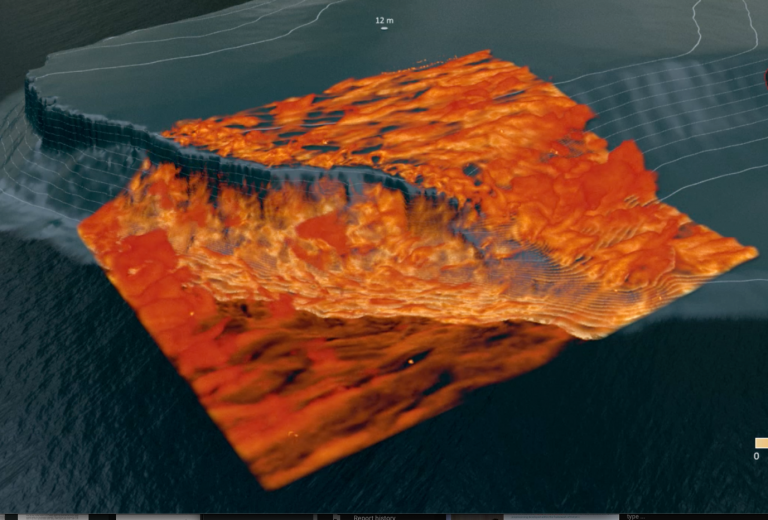
is an open-source non-hydrostatic mesoscale atmospheric model developed by the Centre National de Recherches Météorologiques (CNRM – Météo France/CNRS) and the Laboratoire d’Aérologie (LA – UPS/CNRS) [1]. This LES model has recently been extended to wind farm flow simulations by IFP Energies Nouvelles, using an Actuator Line Model (ALM) of the wind turbines [2]. It enables to simulate the interactions between wind turbines and surrounding atmospheric flows from meso- to micro-scales. A realistic atmosphere can be simulated with this model, including roughness effects, thermal effects, complex terrains, or even complex micro-physical phenomena.
Read More
waLBerla-wind
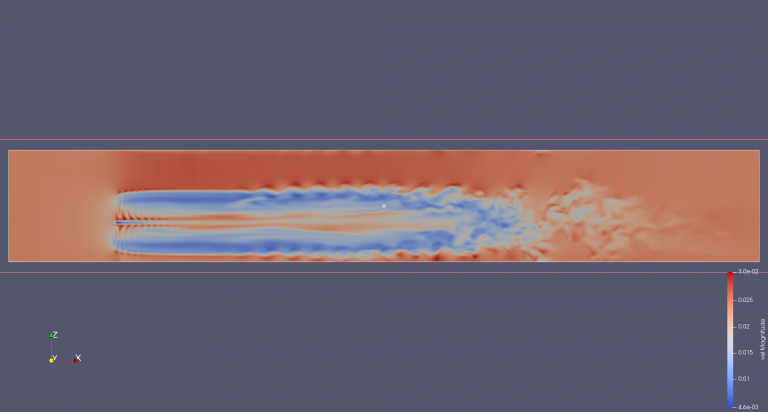
is an exascale-enabled tool allowing for the simulation of neutral atmospheric boundary layers and wind turbines based on the Lattice-Boltzmann method and the waLBerla framework. In EoCoE-3, it will be employed as an alternative solution for modelling wind turbines and wind farms, efficiently using heterogeneous computing resources. Thanks to the code generation techniques, vectorization via SIMD intrinsics and reduced floating-point precisions, waLBerla-wind can perform real-time simulations of the interactions between wind farm clusters.
Read MoreRecent developments and scientific results
Results
GYSELAX DEVELOPMENT
1. The periphery of the confined plasma in tokamaks is characterized by plasma-wall interactions which govern many of its properties. This region, called the SOL (Scrape-Off Layer) is not a mere boundary condition for the core plasma: it is suspected – and partly observed in certain regimes – to impact fusion performance, and it controls the way power is conducted to and deposited on the target plates of the divertor (the element specifically designed to handle the large power out fluxes and particle exhaust).
Immersed boundary conditions – using an adapted version of the penalization technique already operational in the companion fluid code Tokam3X – have been implemented and successfully tested in the version of GYSELA with adiabatic electrons. Both Vlasov and Poisson equations have been modified: mask functions have been implemented to account for the presence of a limiter – a perfect sink for the plasma – and for the expected electron response in the SOL. Preliminary tests especially show the buildup of a well of the radial electric field in the vicinity of the core-SOL boundary, as experimentally observed in experiments. This is very good news, since such a sheared electric field, if large enough, can lead to improved confinement regimes in tokamak plasmas, the so-called “H-mode.”
2. Several Multigrid solvers have been tested on a reduced problem – using a 2-dimensional multi-grid solver – in view of providing efficient solutions for the GyselaX field solver when using very large grids: (i) a flux surface aligned polar mesh and (ii) a locally refined Cartesian mesh. Both options have advantages and drawbacks: while the former is well adapted to the intrinsically anisotropic turbulence in tokamak plasmas, there is no singularity issue at the magnetic axis with the latter.
AMReX has revealed the most appropriate adaptive mesh refinement library for our purpose. In case (i), a mapping from a block-structured logical grid refined at the edge to the circular physical domain has been implemented, yet leaving the magnetic axis unsolved. Good numerical performance in terms of scalability and accuracy for both approaches has been obtained with OpenMP on a single node, although the multigrid solver required considerably fewer iterations on the Cartesian domain. The MPI parallelization on several nodes is ongoing.
In parallel, a polar multigrid solver has been developed from scratch on a mesh that can be strongly refined in the radial direction (collaboration MPG-IPP / CERFACS). This solver, specifically adapted to our problem, should overcome the above issues encountered when using “on-the-shelves” libraries. Promising results have already been obtained in circular and shaped geometries. The solver will now be coupled to the GyselaX code.
3. The use of non-equidistant meshes also impacts the treatment of the Vlasov equation governing the time evolution of the distribution functions. To this end, preliminary coupling tests of a non-equidistant spline module have been performed on prototype codes – the VOICE code and the SELALIB library (collaboration CEA-IRFM / MPG-IPP) – and reveal conclusive. The coupling to the GyselaX code is in progress.
Videos with research results using Alya simulations on wind flows can be found here
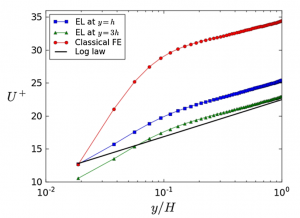
EoCoE team introduces order of magnitude improvement in wall modelling implementation for Finite Elements
Large-eddy simulation (LES) has emerged as a valuable tool for the simulation of turbulent flows at high Reynolds numbers and complex geometries, typically encountered in practical engineering applications. In this approach, the larger dynamically important eddies are directly resolved, whereas the smaller ones are assumed to have a universal character and are therefore modeled.
Nearly all real-world problems include a boundary that acts as a wall where the velocity is zero. In the case of Atmospheric Boundary Layer (ABL) flows that are of interest for Wind Energy, the ground is the wall. For wall-bounded flows, the computational cost becomes prohibitively expensive since the dynamically important eddies in the near-wall region become smaller as the Reynolds number increases, and thus, extreme mesh refinement is required to resolve them. Modeling the inner part of the boundary layer with a semiempirical wall model, instead of resolving it, is therefore a key ingredient for high Reynolds numbers flows to be solvable with LES. Even with the most powerful Exascale Supercomputers that will be available in the upcoming years, wall resolved LES simulations of Atmospheric Boundary Layer flows will not be feasible.
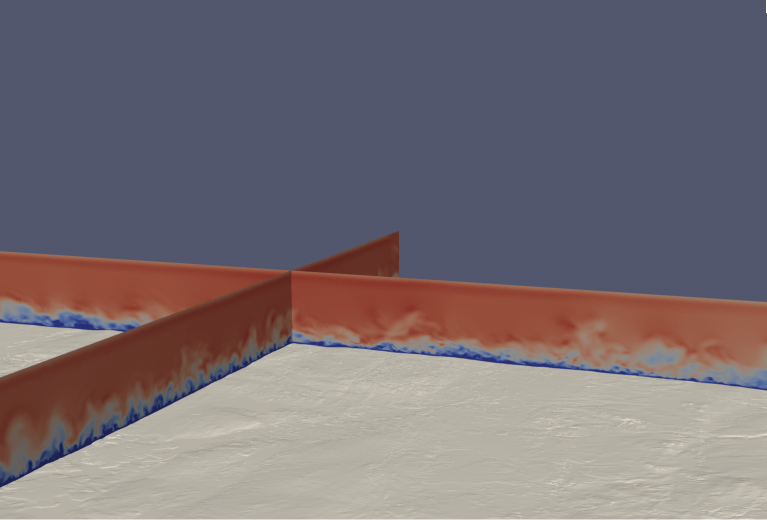
In a recent publication entitled “Wall-modeled large-eddy simulation in a finite element framework” we have improved the wall modelling implementation that has traditionally been used by the Computational Fluid Dynamics Finite Element community. When comparing with the traditional approach the error in the prediction of the mean velocity for high Reynolds number flows has been reduced by more than an order of magnitude. For Atmospheric Boundary Layer flows that have a particularly high Reynolds number this has been a key enabler. The traditional approach used by the Finite Element community would predict an average velocity that is approximately twice the correct value, rendering the results of little or no real use. With the improvements we have implemented the error is significantly reduced and Finite Elements become a very competitive solution for ABL flows. For y/H >0.06, that covers the region of interest of wind energy applications, an excellent prediction is obtained.
EoCoE team improves wind turbine simulation using Lattice-Boltzmann method
In order to better understand the flow physics in a wind farm, we need to compute the detailed flow characteristics like wind velocity, turbulent eddies, etc. in a reasonable time and with enough precision. At this stage only high-fidelity Navier-Stokes based Large-Eddy-Simulation (LES) solvers or even meteorological LES flow solvers are able to accurately reproduce such flows, and have been used rather extensively in the wind energy community. Such simulations enable the understanding of some flow phenomena and are very helpful in the improvement of analytical models. However, due to their high computational cost, only canonical cases are considered (single to few turbines), and full wind farm simulations have only been considered either for demonstration purposes or employing mesh resolutions that are not sufficient to accurately represent the flow physics.
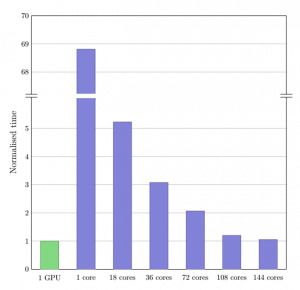
To address this issue, FAU University together with IFPEN are currently implementing actuator-line based wind turbine models in the waLBerla LBM flow solver, with particular attention devoted to the collision operators. Whereas the Lattice-Boltzmann method is well-suited for lower Reynolds number regimes, standard collision operators suffer from instabilities at the high Reynolds numbers observed in wind energy applications. To obtain a stable and meaningful simulation, several investigations are conducted, typically using the Single and/or Multiple Relaxation Time collision operators together with different subgrid-scale models, such as e.g. the Smagorinsky and the WALE models. As this approach failed to stabilize the simulation sufficiently, more advanced collision operators, namely entropic, regularised, and cumulant-based are studied. For the wind turbine application, the cumulant Lattice-Boltzmann methods performed best in terms of stability. They have already been validated considering single or tandem wind turbines, and are being ported to Graphical Processing Units (GPU). The following figures illustrate the obtained results using CPU and GPU resources for the NewMexico wind Turbine. For this compressible simulation, Smagorinsky model is used with D3Q27 stencil and SRT collision operator. The simulation on one GPU (NVIDIA P100) substantially and expectedly outperforms the simulation on one CPU core (Intel Skylake G-6140) without any accuracy loss. Eight full nodes, i.e. 144 CPU cores, are required to obtain the same time-to-solution for both CPU and GPU systems.
Scientific publications related to the Fusion for Energy challenge.
Publications
Conferences
Transport in Fusion Plasmas: Is the Tail Wagging the Dog? – Role of Boundaries in SOL-Edge-Core Interplay
G. Dif-Pradalier, Ph. Ghendrih, Y. Sarazin, F. Widmer, Y. Camenen, X. Garbet, C. Gillot, V. Grandgirard, L. Vermare
4th Asia Pacific Conference on Plasma Physics “AAPPS-DPP2020” (October 2020, e-conference)
All the project publications in this area are available here.
About Company
Innovating for a Sustainable Future
Rays of Progress & Solar Success serves as a powerful beacon, embodying the transformative journey toward a future powered by the boundless Energy of the sun. It's a vision where each
Partner Awaits
Harness the power of water with our AquaForce.
Global Experts
Wind turbines Powering a greener tomorrow.
Project Success
Clients Reviews
Team Members
Winning Awards
OUR EXPERIENCE
Solar Passion Unveiled Our Story
Business, or everyday living, imagine a world where solar success is not just an aspiration but a reality driven by the Rays of the sun.
Hybrid Energy
Solar Panel
Wind Turbines
Expert Member
Solar Design Engineer

25,000 Customer
Satisfaction services

consultation
High Quality Solar Energy Solutions
Solar Powering Your Sustainable Scene is a vibrant and compelling phrase that conveys the idea of integrating solar energy into various aspects of life to create a sustainable
- The Environmental Benefits of Solar Energy
- Maximizing Your Renewable Investment
Work in Progress
This section is currently being updated. Please check back soon for more information.