


Numerical challenges for the simulation of magnetic fusion plasmas
Date: April 1st, 2020, 11 AM
speaker: Leonardo Bautista Gomez, Senior researcher at BSC, and Kai Keller, Software engineer at BSC
Registration url: https://attendee.gotowebinar.com/register/2628884328056255755
abstract: Large scale infrastructures for distributed and parallel computing offer thousands of computing nodes to their users to satisfy their computing needs.
As the need for massively parallel computing increases in industry and development, cloud infrastructures and computing centers are being forced to increase in size and to transition to new computing technologies.
While the advantage for the users is clear, such evolution imposes significant challenges, such as energy consumption and fault tolerance.
Fault tolerance is even more critical in infrastructures built on commodity hardware.
Recent works have shown that large scale machines built with commodity hardware experience more failures than previously thought.
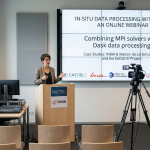
In this webinar, Leonardo Bautista Gomez and Kai Keller, respectively Senior Researcher and Software Engineer at the Barcelona Supercomputing Center, will focus on how to guarantee high reliability to high-performance applications running in large infrastructures. In particular, they will cover all the technical content necessary to implement scalable multilevel checkpointing for tightly coupled applications.
This will include an overview of the internals of the FTI library, and explain how multilevel checkpointing is implemented today, together with examples that the audience can test and analyze on their own laptops, so that they learn how to use FTI in practice, and ultimately transfer that knowledge to their production systems.
Hosted by Prof. Eric Sonnendrücker of the Max-Planck Institute for Plasma Physics, this webinar will dive into magnetic fusion research, a scientific field pursued in order to provide a clean energy available on demand.
EoCoE is a European Horizon 2020 funded project of Centre of Excellence in computing applications. It is designed to enhance numerical simulation efficiency in the international context of the High Performance Computing (HPC) challenges. It focusses its application scope towards low carbon energy domains.
To measure solar energy's profound impact, we must contemplate the “carbon footprint” — a metric that quantifies the total greenhouse gas emissions caused by an individual, organization, event, or product. Traditional electricity production contributes heavily to a nation's footprint, with fossil fuels being the predominant energy source. By harnessing solar energy, we offset these emissions and aid in the progressive decline of our collective carbon footprint.
Switching to solar is more than energy change it's a commitment to a future with reduced carbon emissions
- Roberto Liam
Our Role in Solar Advancement
To measure solar energy's profound impact, we must contemplate the “carbon footprint” — a metric that quantifies the total greenhouse gas emissions caused by an individual, organization, event, or product. Traditional electricity production contributes heavily to a nation's footprint, with fossil fuels being the predominant energy source. By harnessing solar energy, we offset these emissions and aid in the progressive decline of our collective carbon footprint.

In the battle against climate change, the shift towards renewable energy sources plays a pivotal role. Among these, solar energy emerges as a beacon of hope and innovation. Positioned as both a clean and inexhaustible source of power, solar energy has shown significant promise in reducing global carbon emissions. Let’s explore how the adoption of solar power is making strides in the journey towards a more sustainable future.
Active participation from both consumers and industries in the solar movement is imperative. It includes transitioning to solar power where feasible, supporting policies that encourage