
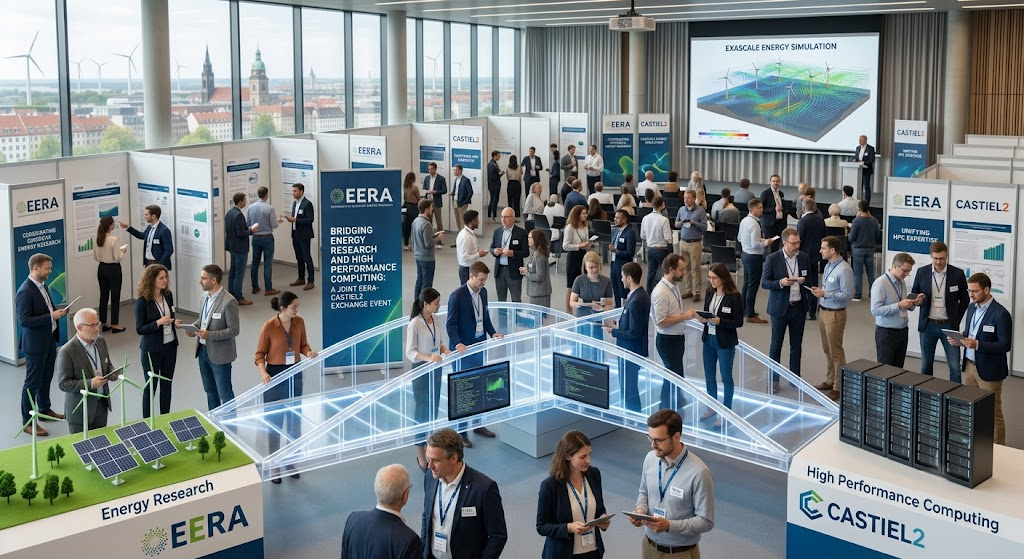
Bridging Energy Research and High Performance Computing: a Joint EERA-CASTIEL2 Exchange Event
02 Jul 2025
The European Energy Research Alliance (EERA) and CASTIEL2, representing the network of EuroHPC National Competence Centres and the European HPC Centres of Excellence (CoEs), have organized a joint webinar event aimed at strengthening synergies between the energy research community and high performance computing (HPC) experts.
This collaborative forum seeks to bring together researchers, technology developers, and stakeholders from both domains to:
- Share insights and challenges in energy-related research requiring HPC resources.
- Explore existing HPC solutions, tools, and infrastructures available through EuroHPC.
- Identify common ground for future cooperation and co-design of computational tools.
- Encourage matchmaking for collaborative projects and innovation-driven partnerships.
EoCoE is a European Horizon 2020 funded project of Centre of Excellence in computing applications. It is designed to enhance numerical simulation efficiency in the international context of the High Performance Computing (HPC) challenges. It focusses its application scope towards low carbon energy domains.

To measure solar energy's profound impact, we must contemplate the “carbon footprint” — a metric that quantifies the total greenhouse gas emissions caused by an individual, organization, event, or product. Traditional electricity production contributes heavily to a nation's footprint, with fossil fuels being the predominant energy source. By harnessing solar energy, we offset these emissions and aid in the progressive decline of our collective carbon footprint.
Switching to solar is more than energy change it's a commitment to a future with reduced carbon emissions
- Roberto Liam
Our Role in Solar Advancement
To measure solar energy's profound impact, we must contemplate the “carbon footprint” — a metric that quantifies the total greenhouse gas emissions caused by an individual, organization, event, or product. Traditional electricity production contributes heavily to a nation's footprint, with fossil fuels being the predominant energy source. By harnessing solar energy, we offset these emissions and aid in the progressive decline of our collective carbon footprint.
In the battle against climate change, the shift towards renewable energy sources plays a pivotal role. Among these, solar energy emerges as a beacon of hope and innovation. Positioned as both a clean and inexhaustible source of power, solar energy has shown significant promise in reducing global carbon emissions. Let’s explore how the adoption of solar power is making strides in the journey towards a more sustainable future.
Active participation from both consumers and industries in the solar movement is imperative. It includes transitioning to solar power where feasible, supporting policies that encourage