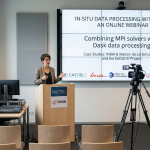
Numerical challenges for the simulation of magnetic fusion plasmas
Date: 15/05/2020, 10.30 am
speaker: Prof. Dr. Eric Sonnendrücker, Head of Numerical Methods in Plasma Physics Division at the Max Planck Institute for Plasma Physics
Registration url: https://attendee.gotowebinar.com/register/7722234506387424779
abstract: The principle behind magnetic fusion research is to confine a plasma, which is a gas of charged particles at a very large temperature, around 100 000 degrees, so that the fusion reaction can generate energy with a positive balance.
At such a high temperature, the plasma needs to be completely isolated from the wall of the reactor.
This isolation can be achieved in toroidal devices thanks to a very large magnetic field.
Due to the multiple and complex physical processes involved, theoretical research in this field relies heavily on numerical simulations and some problems require huge computational resources.
After introducing the context of magnetic confinement fusion, we shall address different specific challenges for numerical simulations in this topic, which are in particular related to the multiple space and time scales that need to be spanned and to the geometry of the experimental devices.
These can only be solved thanks to a close collaboration between physicists, mathematicians and HPC specialists.
A few current research problems in this field going from the computation of a 3D equilibrium to fluid and kinetic simulations will be presented as an illustration.
Hosted by Prof. Eric Sonnendrücker of the Max-Planck Institute for Plasma Physics, this webinar will dive into magnetic fusion research, a scientific field pursued in order to provide a clean energy available on demand.
EoCoE is a European Horizon 2020 funded project of Centre of Excellence in computing applications. It is designed to enhance numerical simulation efficiency in the international context of the High Performance Computing (HPC) challenges. It focusses its application scope towards low carbon energy domains.
To measure solar energy's profound impact, we must contemplate the “carbon footprint” — a metric that quantifies the total greenhouse gas emissions caused by an individual, organization, event, or product. Traditional electricity production contributes heavily to a nation's footprint, with fossil fuels being the predominant energy source. By harnessing solar energy, we offset these emissions and aid in the progressive decline of our collective carbon footprint.
Switching to solar is more than energy change it's a commitment to a future with reduced carbon emissions
- Roberto Liam
Our Role in Solar Advancement
To measure solar energy's profound impact, we must contemplate the “carbon footprint” — a metric that quantifies the total greenhouse gas emissions caused by an individual, organization, event, or product. Traditional electricity production contributes heavily to a nation's footprint, with fossil fuels being the predominant energy source. By harnessing solar energy, we offset these emissions and aid in the progressive decline of our collective carbon footprint.
In the battle against climate change, the shift towards renewable energy sources plays a pivotal role. Among these, solar energy emerges as a beacon of hope and innovation. Positioned as both a clean and inexhaustible source of power, solar energy has shown significant promise in reducing global carbon emissions. Let’s explore how the adoption of solar power is making strides in the journey towards a more sustainable future.
Active participation from both consumers and industries in the solar movement is imperative. It includes transitioning to solar power where feasible, supporting policies that encourage