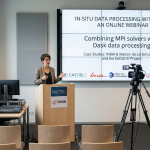
Parallel Matrix-free Multigrid for Extreme Scale Computing

Date: 28/01/2021, 2 pm

speaker: Dr. Ulrich Ruede (FAU Erlangen-Nürnberg and CERFACS Toulouse)

abstract:

This webinar will focus on parallel matrix-free multigrid for extreme scale computing.
Multigrid is one of the most efficient algorithms to solve linear systems for elliptic partial differential equations, and matrix-free variants are essential to reach the best possible performance.
 
This will be demonstrated for positive definite systems as they arise in the discretization of the gyrokinetic Poisson equation, as well as indefinite systems that originate in viscous flow problems.
 
During this webinar, special attention will be given to the coarse grids of the multigrid hierarchy to avoid that they become a sequential bottleneck. Modern sparse direct methods and their approximate form using block-low-rank approximations will be used.
 
The talk will include a scalability study, aiming to solve a linear system with more than ten trillion unknowns, equivalent to a solution vector as big as 80 TByte in main memory.
Dr. Ulrich Ruede (FAU Erlangen-Nürnberg and CERFACS, Toulouse) will host this webinar, organized by the European Energy-Oriented Center of Excellence (EoCoE). 
 
The webinar is free and open to everyone, and will be recorded to be later available on the EoCoE YouTube channel.
EoCoE is a European Horizon 2020 funded project of Centre of Excellence in computing applications. It is designed to enhance numerical simulation efficiency in the international context of the High Performance Computing (HPC) challenges. It focusses its application scope towards low carbon energy domains.

To measure solar energy's profound impact, we must contemplate the “carbon footprint” — a metric that quantifies the total greenhouse gas emissions caused by an individual, organization, event, or product. Traditional electricity production contributes heavily to a nation's footprint, with fossil fuels being the predominant energy source. By harnessing solar energy, we offset these emissions and aid in the progressive decline of our collective carbon footprint.

Switching to solar is more than energy change it's a commitment to a future with reduced carbon emissions
- Roberto Liam

Our Role in Solar Advancement

To measure solar energy's profound impact, we must contemplate the “carbon footprint” — a metric that quantifies the total greenhouse gas emissions caused by an individual, organization, event, or product. Traditional electricity production contributes heavily to a nation's footprint, with fossil fuels being the predominant energy source. By harnessing solar energy, we offset these emissions and aid in the progressive decline of our collective carbon footprint.

In the battle against climate change, the shift towards renewable energy sources plays a pivotal role. Among these, solar energy emerges as a beacon of hope and innovation. Positioned as both a clean and inexhaustible source of power, solar energy has shown significant promise in reducing global carbon emissions. Let’s explore how the adoption of solar power is making strides in the journey towards a more sustainable future.

Active participation from both consumers and industries in the solar movement is imperative. It includes transitioning to solar power where feasible, supporting policies that encourage