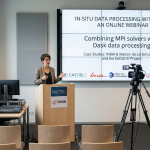
Performance engineering as key technology to reach exascale
Date: 11/11/2017
speaker: G. Wellein
00:00:00 Introduction
00:05:59 Agenda
00:07:48 Performance Engineering
00:12:17 “Our” PE cycle — white boxes only
00:16:59 Node level performance models – roofline and beyond
00:17:29 Potential hardware capabilities, a.k.a. bottlenecks
00:19:34 The Roofline model*: Execution vs. Data transfer
00:25:13 Roofline model
00:27:52 First order correction: Execution Cache Memory [ECM] Model
00:29:06 Roofline vs. ECM model — a 3D 7pt stencil
00:31:06 Node level performance models – hardware models done right
00:31:30 Imbench: Determine basic machine characteristics
00:32:06 Imbench: frd [full read-only bandwidth]
00:36:13 frd performance — the problem
00:36:57 Read-only bandwidth — done better: ddot [a,b]
00:37:49 Performance engineering for sparse linear algebra
00:38:23 ESSEX project — background
00:39:53 PE in sparse linear algebra chebyshev polynomials
00:40:48 Compute Chebyshev polynomials / moments
00:46:05 Application model: Code Balance [Bc]
00:47:09 Roofline performance model: CPU
00:47:33 Single-nodeI-device performance & bottlenecks
00:48:42 Large-scale Heterogeneous Performance
00:49:49 Never trust a stranger
00:52:49 Tall & Skinny [TS] Matrix-Matrix-Multiplication
00:59:37 Multicoloring
00:59:52 Hardware efficient Kaczmarz solver
01:03:08 Summary

EoCoE is a European Horizon 2020 funded project of Centre of Excellence in computing applications. It is designed to enhance numerical simulation efficiency in the international context of the High Performance Computing (HPC) challenges. It focusses its application scope towards low carbon energy domains.
To measure solar energy's profound impact, we must contemplate the “carbon footprint” — a metric that quantifies the total greenhouse gas emissions caused by an individual, organization, event, or product. Traditional electricity production contributes heavily to a nation's footprint, with fossil fuels being the predominant energy source. By harnessing solar energy, we offset these emissions and aid in the progressive decline of our collective carbon footprint.
Switching to solar is more than energy change it's a commitment to a future with reduced carbon emissions
- Roberto Liam
Our Role in Solar Advancement
To measure solar energy's profound impact, we must contemplate the “carbon footprint” — a metric that quantifies the total greenhouse gas emissions caused by an individual, organization, event, or product. Traditional electricity production contributes heavily to a nation's footprint, with fossil fuels being the predominant energy source. By harnessing solar energy, we offset these emissions and aid in the progressive decline of our collective carbon footprint.
In the battle against climate change, the shift towards renewable energy sources plays a pivotal role. Among these, solar energy emerges as a beacon of hope and innovation. Positioned as both a clean and inexhaustible source of power, solar energy has shown significant promise in reducing global carbon emissions. Let’s explore how the adoption of solar power is making strides in the journey towards a more sustainable future.
Active participation from both consumers and industries in the solar movement is imperative. It includes transitioning to solar power where feasible, supporting policies that encourage