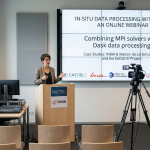


The A64FX processor: Understanding streaming kernels and sparse matrix-vector multiplication
Date: 18/11/2020, 10 am
speaker: – Christie L. Alappat, Erlangen Regional Computing Center (RRZE), PhD student in the group of Prof. G. Wellein – Dr. Georg Hager, Erlangen Regional Computing Center (RRZE), Senior researcher in the HPC division at RRZE
Registration url: https://attendee.gotowebinar.com/register/3926945771611115789
abstract: The A64FX CPU powers the current #1 supercomputer on the Top500 list.
Although it is a traditional cache-based multicore processor, its peak performance and memory bandwidth rival accelerator devices.
Generating efficient code for such a new architecture requires a good understanding of its performance features. Using these features, the Erlangen Regional Computing Center (RRZE) team will detail how they construct the Execution-Cache-Memory (ECM) performance model for the A64FX processor in the FX700 supercomputer and validate it using streaming loops.
They will describe how the machine model points to peculiarities in the microarchitecture to keep in mind when optimizing applications, and how, applying the ECM model to sparse matrix-vector multiplication (SpMV), they motivate why the CRS matrix storage format is inappropriate and how the SELL-C-sigma format can achieve bandwidth saturation for SpMV.
In this context, they will also look into some code optimization strategies that are relevant for A64FX and compare SpMV performance with AMD Rome, Intel Cascade Lake and NVIDIA V100. This webinar, organized by the European Energy-Oriented Center of Excellence (EoCoE), will be hosted by Christie L. Alappat, PhD student at the RRZE, and Dr. Georg Hager, senior researcher in the HPC division at RRZE.
The webinar is free and open to everyone, and will be recorded to be later available on the EoCoE YouTube channel.

EoCoE is a European Horizon 2020 funded project of Centre of Excellence in computing applications. It is designed to enhance numerical simulation efficiency in the international context of the High Performance Computing (HPC) challenges. It focusses its application scope towards low carbon energy domains.
To measure solar energy's profound impact, we must contemplate the “carbon footprint” — a metric that quantifies the total greenhouse gas emissions caused by an individual, organization, event, or product. Traditional electricity production contributes heavily to a nation's footprint, with fossil fuels being the predominant energy source. By harnessing solar energy, we offset these emissions and aid in the progressive decline of our collective carbon footprint.
Switching to solar is more than energy change it's a commitment to a future with reduced carbon emissions
- Roberto Liam
Our Role in Solar Advancement
To measure solar energy's profound impact, we must contemplate the “carbon footprint” — a metric that quantifies the total greenhouse gas emissions caused by an individual, organization, event, or product. Traditional electricity production contributes heavily to a nation's footprint, with fossil fuels being the predominant energy source. By harnessing solar energy, we offset these emissions and aid in the progressive decline of our collective carbon footprint.

In the battle against climate change, the shift towards renewable energy sources plays a pivotal role. Among these, solar energy emerges as a beacon of hope and innovation. Positioned as both a clean and inexhaustible source of power, solar energy has shown significant promise in reducing global carbon emissions. Let’s explore how the adoption of solar power is making strides in the journey towards a more sustainable future.
Active participation from both consumers and industries in the solar movement is imperative. It includes transitioning to solar power where feasible, supporting policies that encourage