

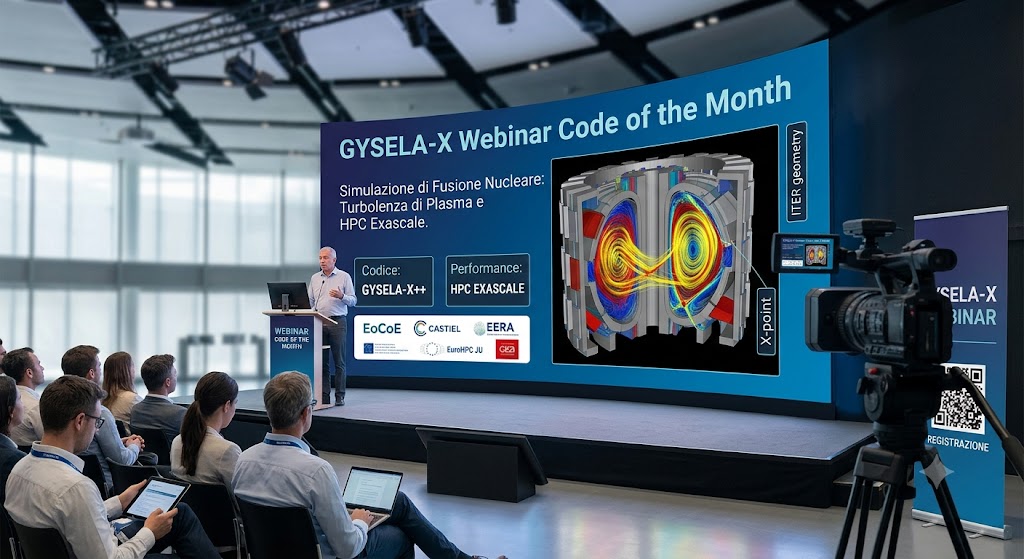
GYSELA-X Webinar Code of the month
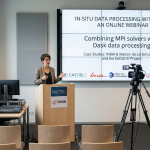
GYSELA-X, a code used to model turbulent transport in tokamak plasmas, will be presented during a webinar on 25th June 2025 @03:00 PM CEST with a presentation by EOCOE.
Peter Donner, from CEA’s IRFM, will give this talk as part of CASTIEL’s long-running “Code of the month” webinar series.
The registration link is : https://attendee.gotowebinar.com/register/627656660115856217
After registering, you will receive a confirmation email containing information about joining the webinar.
Fusion research is in full swing. Various concepts have been proposed for confining extremely hot plasmas (several hundred million degrees) long enough to produce energy from fusion reactions. Among these concepts, the tokamak is currently the most promising and has been chosen for the international ITER project currently under construction on the Cadarache site in the south of France. The success of this project depends in particular on understanding and predicting the turbulent transport of particles and heat within the plasma.
Tokamak plasmas are not very collisional and therefore require a kinetic description. In addition, plasma confinement increases sharply with the ratio between the size of the machine and the size of the turbulent structures. However, a good description of the confinement requires simulation of all the scales present. So the numerical cost of simulating a tokamak plasma is significant and increases with its quality.
The GYSELA code is used to model turbulent transport in tokamak plasmas. We will look at the capabilities of the current code through a few examples and discuss the limitations of the code. We will see that the development of a new code is necessary, both to improve the physical model and to increase the size of the simulated plasmas. This new code will make it possible to use Exascale supercomputers that will be needed to model ITER plasmas.
EoCoE is a European Horizon 2020 funded project of Centre of Excellence in computing applications. It is designed to enhance numerical simulation efficiency in the international context of the High Performance Computing (HPC) challenges. It focusses its application scope towards low carbon energy domains.
To measure solar energy's profound impact, we must contemplate the “carbon footprint” — a metric that quantifies the total greenhouse gas emissions caused by an individual, organization, event, or product. Traditional electricity production contributes heavily to a nation's footprint, with fossil fuels being the predominant energy source. By harnessing solar energy, we offset these emissions and aid in the progressive decline of our collective carbon footprint.
Switching to solar is more than energy change it's a commitment to a future with reduced carbon emissions
- Roberto Liam
Our Role in Solar Advancement
To measure solar energy's profound impact, we must contemplate the “carbon footprint” — a metric that quantifies the total greenhouse gas emissions caused by an individual, organization, event, or product. Traditional electricity production contributes heavily to a nation's footprint, with fossil fuels being the predominant energy source. By harnessing solar energy, we offset these emissions and aid in the progressive decline of our collective carbon footprint.

In the battle against climate change, the shift towards renewable energy sources plays a pivotal role. Among these, solar energy emerges as a beacon of hope and innovation. Positioned as both a clean and inexhaustible source of power, solar energy has shown significant promise in reducing global carbon emissions. Let’s explore how the adoption of solar power is making strides in the journey towards a more sustainable future.
Active participation from both consumers and industries in the solar movement is imperative. It includes transitioning to solar power where feasible, supporting policies that encourage